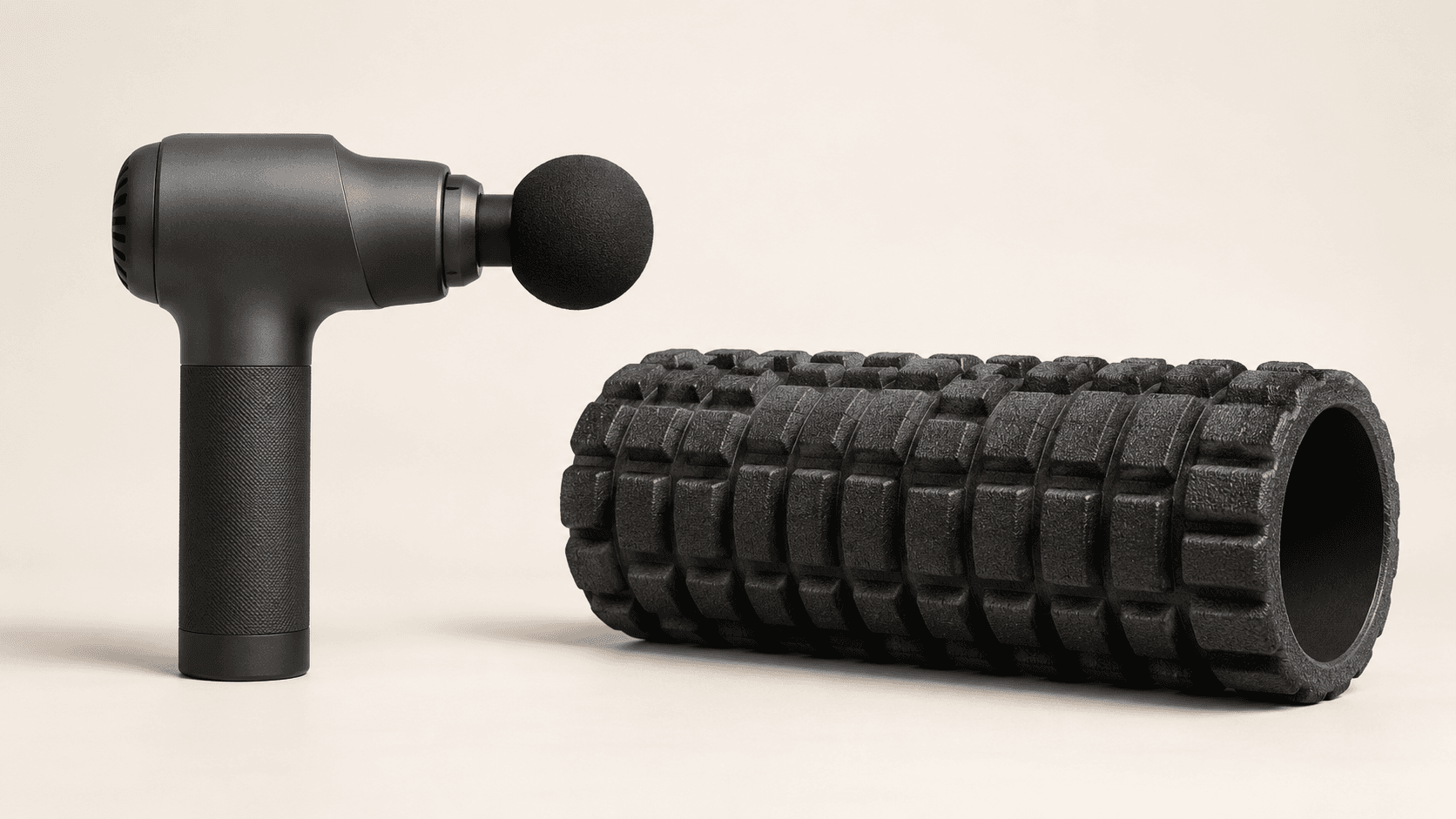
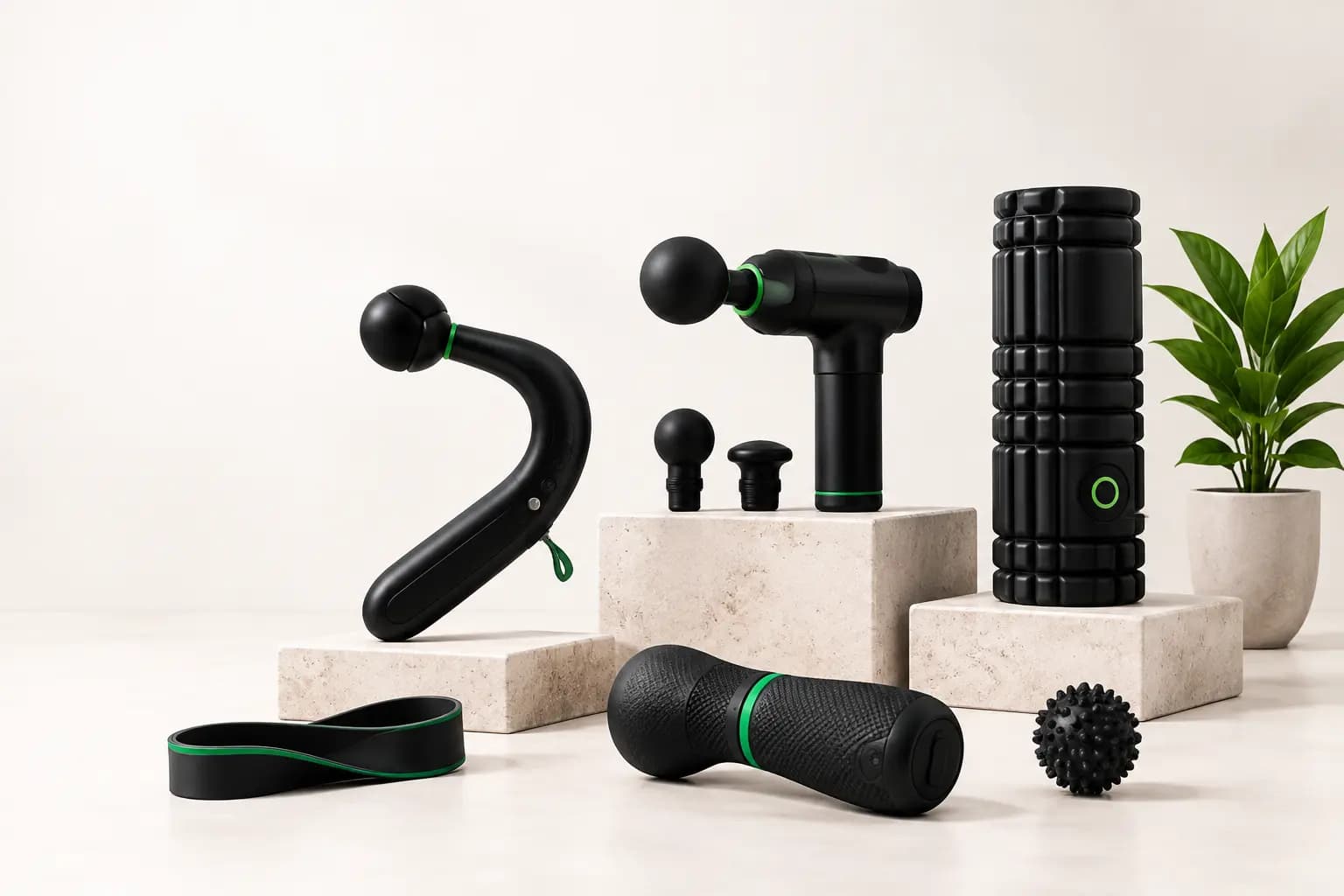
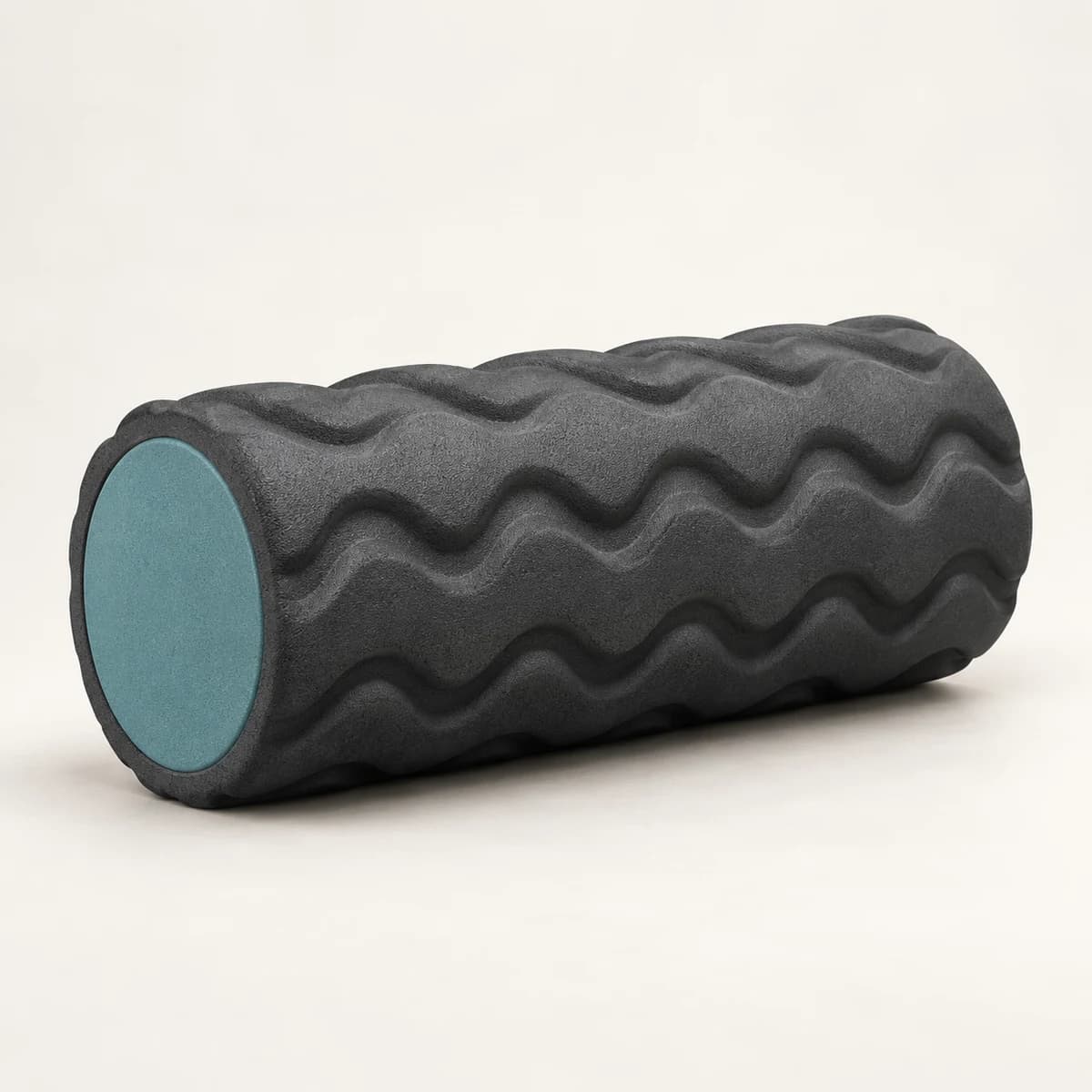
 Illustrative category image — not the exact product
Review basis and testing disclosure
RecoveryToolLab has not hands-on tested the TriggerPoint GRID 1.0. This review uses current TriggerPoint specifications and independent systematic reviews of foam rolling.
We did not verify firmness, comfort, surface wear, cleaning or long-term shape retention. No product score, consumer rating or live price is reproduced.
What the GRID 1.0 is
The GRID 1.0 is a 13-inch foam roller with an EVA foam exterior over a rigid hollow core. TriggerPoint lists dimensions of 13 by 5.5 by 5.5 inches, a one-year warranty and a stated maximum supported weight of 300 pounds.
The surface combines flatter areas, ridges and raised nodules. TriggerPoint markets those zones as approximating different forms of manual contact. That description explains the geometry; it does not establish that the roller reproduces a clinician’s hands or outcomes.
Design assessment
Portable length
The 13-inch body is shorter than many full-length rollers. It should be easier to store and carry, but provides less width for positions where a user wants broad support.
Hollow core
The rigid core is intended to retain shape and provide consistent resistance. RecoveryToolLab has not verified its long-term durability or comfort compared with a solid foam roller.
Patterned EVA surface
The water- and sweat-resistant EVA surface is documented as cleanable with mild soap and water. Raised zones change local contact pressure, but the practical difference depends on body position and personal tolerance.
No power or app requirement
The roller requires no charging, software or account. Its usefulness depends on having enough space and being able to control body weight safely.
Evidence for foam rolling
A systematic review and multilevel meta-analysis reported acute range-of-motion improvements in healthy adults compared with no exercise, while finding foam rolling was not superior to stretching. Read the range-of-motion review.
A later meta-analysis found no acute change in several measures of myofascial stiffness or isometric strength, with low certainty around some findings. Read the stiffness and strength review. Research on foam rolling as repeated training also found no significant overall performance change. Read the training review.
These category-level findings do not prove that the GRID 1.0 permanently changes fascia, repairs tissue, improves circulation in a clinically meaningful way or treats an injury.
Potential advantages based on verified characteristics
- Compact 13-inch size
- EVA foam exterior over a hollow core
- Multiple surface shapes for broader or more concentrated contact
- No battery, app or charging requirement
- Manufacturer states the surface is water- and sweat-resistant
- One-year manufacturer warranty listed on the official page
Important limitations
- RecoveryToolLab has not tested firmness, comfort or durability.
- The 13-inch width may feel restrictive for some broad-supported positions.
- A rigid hollow core may feel too firm for pressure-sensitive users.
- Patterned texture does not establish superior clinical outcomes.
- Foam-rolling evidence cannot diagnose or explain pain.
- Floor-based use requires space, positioning and body-weight control.
Who may consider it
It may suit someone who wants a compact, non-powered roller and prefers a textured surface over smooth foam. It can also be a simple option for short self-massage sessions when the user can control pressure comfortably.
Who may want to skip it
A softer solid roller may be more appropriate for someone new to pressure or sensitive to firm contact. Skip direct rolling over acute injury, marked swelling, bruising, bony prominences or areas with altered sensation unless a qualified professional advises otherwise.
Safety considerations
Begin with light, controllable pressure and avoid forcing a position. Stop if rolling causes sharp pain, numbness, tingling or worsening symptoms. Foam rolling is not a way to diagnose a muscle, fascia or joint problem.
Persistent pain, progressive neurological symptoms or symptoms after significant trauma require appropriate evaluation rather than stronger rolling pressure.
Alternatives
Smooth foam roller
A smooth roller provides more uniform contact and may be easier to tolerate. It lacks the GRID surface pattern but can serve the same broad category purpose.
Massage ball
A ball is easier to use against a wall and targets a smaller area, but concentrates pressure more sharply.
Percussion massager
A handheld device can reach some areas without floor positioning, but adds cost, noise, charging and a moving contact head.
Value discussion without a price claim
The relevant value factors are compact storage, a rigid core and the textured EVA surface. RecoveryToolLab cannot judge price-to-performance without hands-on durability findings and verified current pricing. Check current merchant and warranty terms before purchase.
Final verdict
The GRID 1.0 is a clearly specified compact roller with a distinctive surface and hollow core. It is a reasonable category option for someone who already wants a firmer textured roller. The documentation does not establish that it outperforms simpler rollers or stretching for meaningful long-term outcomes.
Our review methodology
This edition used TriggerPoint documentation current on October 4, 2026 and peer-reviewed systematic reviews of foam rolling. We separated construction facts from promotional claims and did not infer hands-on performance, prices, rankings or consumer sentiment.
Did RecoveryToolLab test the TriggerPoint GRID 1.0?
No. This review is based on official documentation and independent category-level research, not first-hand use.
Does the GRID 1.0 permanently release fascia?
RecoveryToolLab found no basis for promising a permanent fascial release. Studies report some short-term outcomes, but findings do not validate permanent structural change or every product claim.
Sources and references
Product specifications and manufacturer claims were checked against official TriggerPoint documentation on October 4, 2026. Manufacturer claims were not treated as independent evidence. The manufacturer documentation is identified here for transparency but is not linked as a shopping destination.
- Manufacturer documentation reviewed: TriggerPoint GRID 1.0 official product documentation
- Systematic review of acute range-of-motion effects
- Systematic review of stiffness and strength outcomes
- Systematic review of foam-rolling training