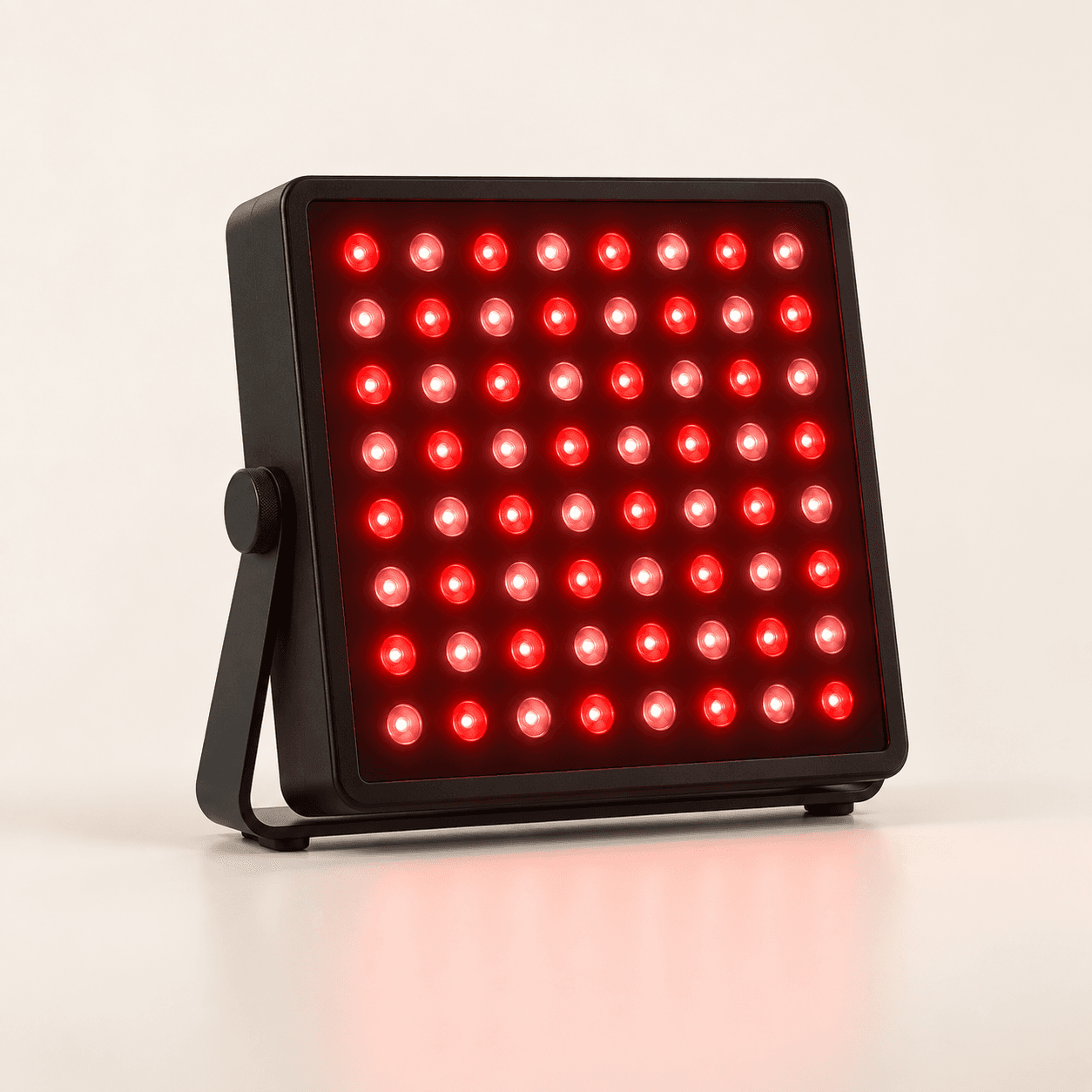
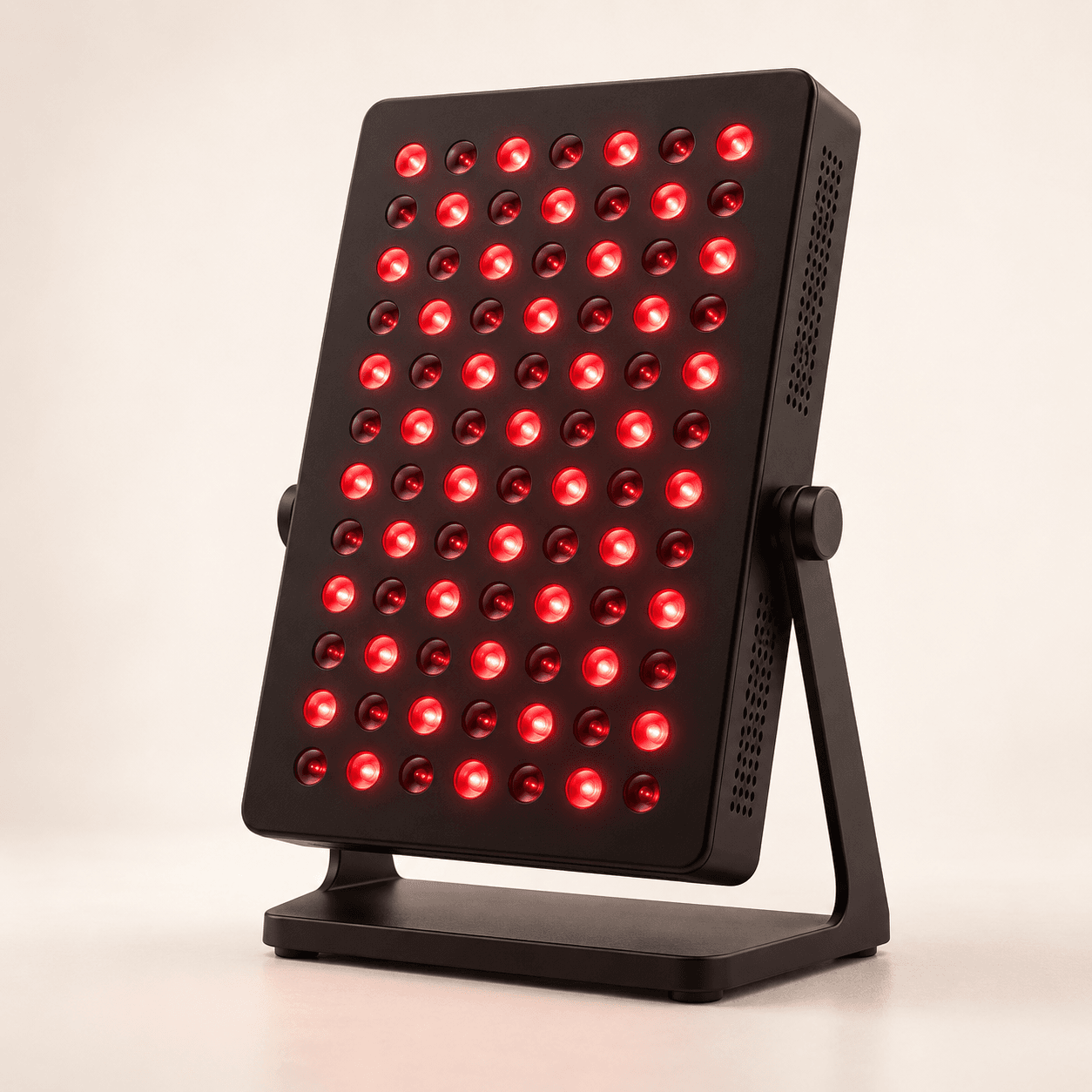
 Illustrative category image — not the exact product
Review basis and testing disclosure
RecoveryToolLab has not hands-on tested the Hooga HG300. This review uses current Hooga documentation, a verified Amazon identity and independent photobiomodulation research. It does not reproduce a live price, Amazon rating or hands-on score.
What the Hooga HG300 is
The HG300 is a compact red and near-infrared LED panel. Hooga lists 60 single-chip LEDs, 660 nm and 850 nm wavelengths, separate light controls, a timer, a foldable tabletop stand, dimensions of 12.2 by 8.2 by 2.5 inches and a weight of six pounds.
Hooga also publishes irradiance measurements. Those are manufacturer measurements and were not independently replicated by RecoveryToolLab.
Design assessment
The tabletop format is intended for targeted rather than full-body coverage. A stand can simplify positioning, but distance, angle, session duration and body area all affect delivered exposure. More LEDs or higher stated output should not be treated as an automatic health-outcome score.
Evidence for photobiomodulation
Research uses varied wavelengths, doses, timing and devices, making results difficult to transfer directly to a consumer panel. A 2025 systematic review reported low-certainty evidence for some photobiomodulation soreness findings and moderate-certainty evidence that intermittent pneumatic compression did not reduce soreness at one measured time point. Read the review.
That evidence does not establish that the HG300 treats pain, injury or disease, or that its consumer-use protocol matches studied protocols.
Potential advantages based on verified characteristics
- Compact tabletop format
- Separate 660 nm red and 850 nm near-infrared output
- Built-in timer and foldable stand
- Published manufacturer specifications
- Verified Amazon US product destination
Important limitations
- RecoveryToolLab did not measure irradiance, heat, noise or electrical behavior.
- Targeted panel size requires repositioning for multiple areas.
- Research protocols are not interchangeable with this specific device.
- Near-infrared light is not fully visible, so brightness is not a dose measure.
- It should not be presented as a treatment for an undiagnosed condition.
Safety considerations
Follow the current device instructions, distance guidance and eye-protection advice. Ask an appropriate clinician before use when photosensitivity, photosensitizing medication, an eye condition, pregnancy or a medical treatment creates uncertainty.
Alternatives
A smaller wearable may be easier to position but covers less area. A larger panel increases coverage but requires more space. Movement, sleep and ordinary training-load management remain more fundamental than a recovery device.
Final verdict
The HG300 is a straightforward compact panel on paper: two wavelengths, 60 LEDs, a timer and tabletop stand. It is reasonable to compare as an entry-level targeted panel, but buyers should not translate wavelength and irradiance specifications into guaranteed recovery results.
Our review methodology
Specifications were checked against current Hooga documentation and the Amazon identity on October 5, 2026. Independent research supplied category context. RecoveryToolLab did not invent testing observations, scores or a live price.
Did RecoveryToolLab test the Hooga HG300?
No. This is a documentation-and-evidence review, not a hands-on test.
Sources and references
Product specifications and manufacturer claims were checked against official Hooga documentation on October 5, 2026. The documentation is identified for transparency but is not linked as a shopping destination.
- Manufacturer documentation reviewed: Hooga HG300 official product documentation
- Systematic review of photobiomodulation and other recovery modalities